
For Contractor Leaders
Do the Job Right on Every Site, Including the Ones You Can’t Visit This Week.
Incidents, rework, and blown schedules grow in the gap between the plan and the job site. P2-Driven HSE gives your frontline leaders a simple system to close it, so your crews do the job right and go home unharmed today.
What You Carry
You Carry Your Crews’ Safety, Your EMR, and a Growth Plan That Depends on Both.
Chances are you came up through the trades or the project side. You know your superintendents by name, you sign the checks, and you take the call when something goes wrong at 2 a.m.
Your clients’ scorecards ride on it too. When a client asks for a safety record, yours is the name on it.
What you want
- Crews Who Go Home the Way They Came to Work
- Jobs That Finish on Schedule and on Budget
- Clients who call you for the next one
- A company that does the job right on every site
What Stands in the Way
The Gap
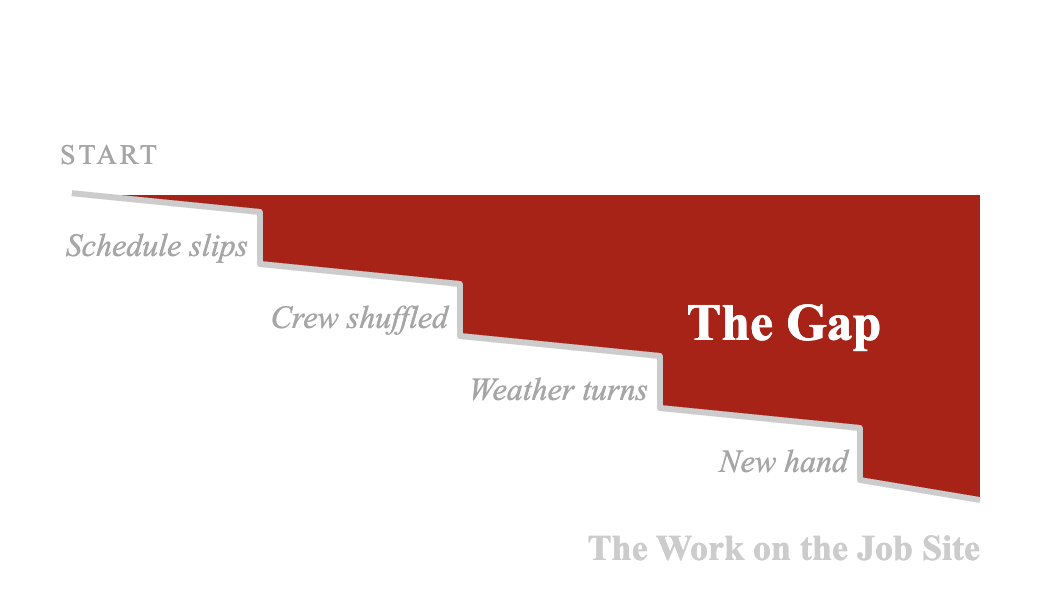
The distance between the plan in the office and the work on the job site.
It grows one small change at a time. The schedule slips, a crew gets shuffled, the weather turns, a new hand shows up Monday. Every change makes sense the day it happens. Nobody chose the Gap. It grew while good people were busy getting the work done.
You’ve seen its faces
- The orientation nobody remembers by lunch.
- The JSA signed before anyone read it.
- The new hand who said he understood.
- The binder on the shelf in the job trailer.
- The foreman who nods at the plan, then does it the old way when the schedule tightens.
The Gap Never Shows Up on the Schedule. It Shows Up in the Incident Report.
What It Costs
What the Gap Costs
On Your Jobs
Incidents, rework, stand-downs, and blown budgets. An EMR that climbs until prequalification turns into a hurdle. Client scorecards that slip. Each one traces back to the Gap.
On You
You’ve bought programs, hired good people, and run the safety meetings, and the numbers still move without warning. Corporate thinks the field isn’t listening. The field thinks corporate doesn’t understand the work. You stand in the middle, wondering what else there is to try.
Doing the job right and sending everyone home unharmed were always the same job.
Your Guide
“I get it. I’ve watched good companies grow faster than their capacity, and I’ve seen the damage it does to their people, their reputation, their insurance rates, and their ability to bid the next job.”Jesse Hardy, CSP
“I started out as a safety cop. I thought safety was black and white, safe or unsafe. It took me years in the field to see what crews actually face every day.”
“I’ve investigated thousands of incidents. The common threads in them became the eight Principles.”
Results
- On a $3B+ Arctic oil development, the total injury rate fell 73% while project hours grew 231%.
- At a right-of-way and civil contractor, profit margin rose from 18% to 22% while the company grew 150% in three years, and EMR fell 56%.
- Across 31 concurrent projects, serious injuries and fatalities went to zero.
Ten years in the field, project to project, then ten years leading HSEQ as a director, VP, and EVP, then 18 months back on the North Slope. CSP, CUSP, and CIT. Speaker at the NSC Annual Conference and the iP Utility Safety Conference, and author of more than a dozen articles in Incident Prevention magazine.
More About Jesse →The Plan
Three Steps to Close the Gap
2 to 4 weeks
Understand the Working Reality.
Jesse walks your sites, talks with crews and leaders, and reviews your incident, observation, and EMR data. You get a map of where the plan and the work drift apart, and a 90-day plan to close the Gap.
3 to 6 months
Set the Purpose and Principles.
Your leaders define a vision, mission, and values crews can say out loud. Supervisors learn the eight Principles and the question behind each one.
Monthly, ongoing
Put It in the Field.
The Boots On The Ground tools go live: pre-job planning, Stop Work, issue reporting, and after action reviews. The General Orientation gets rebuilt around your top risks and your Purpose, and field coaching keeps it in place.
The assessment takes two to four weeks. The rollout runs three to six months. After that, a monthly field coaching visit keeps the gains in place.
What you can count on
What’s at Stake
Two Ways This Goes
Who You Become
From Stuck in the Middle to the Leader Who Closed the Gap
Free Guide
8 Questions for Your Next Site Walk
For contractor leaders who want to see the job the way their crews see it. One page, built on the eight Principles.

