
For Private Equity Owners
Know What’s Happening on the Job Sites Behind Your Board Report.
Across a portfolio, some of the biggest risks to value sit in the gap between the board report and the job site. P2-Driven HSE gives every company one simple system to close it, so crews go home unharmed and the value you build holds up at exit.
What You Carry
You Own the Risk Across Your Companies Without Seeing Their Job Sites.
You think in EBITDA, hold periods, and exits. You count on the management teams who run the job sites, and you carry a value creation plan and a promise to your investors.
Your companies have crews working in high-risk conditions every day. When something goes wrong at one of them, the firm’s name travels with it.
What you want
- Earnings you can predict
- Companies that grow with the work under control
- Add-ons that plug in cleanly
- An exit where the safety record helps the story
What Stands in the Way
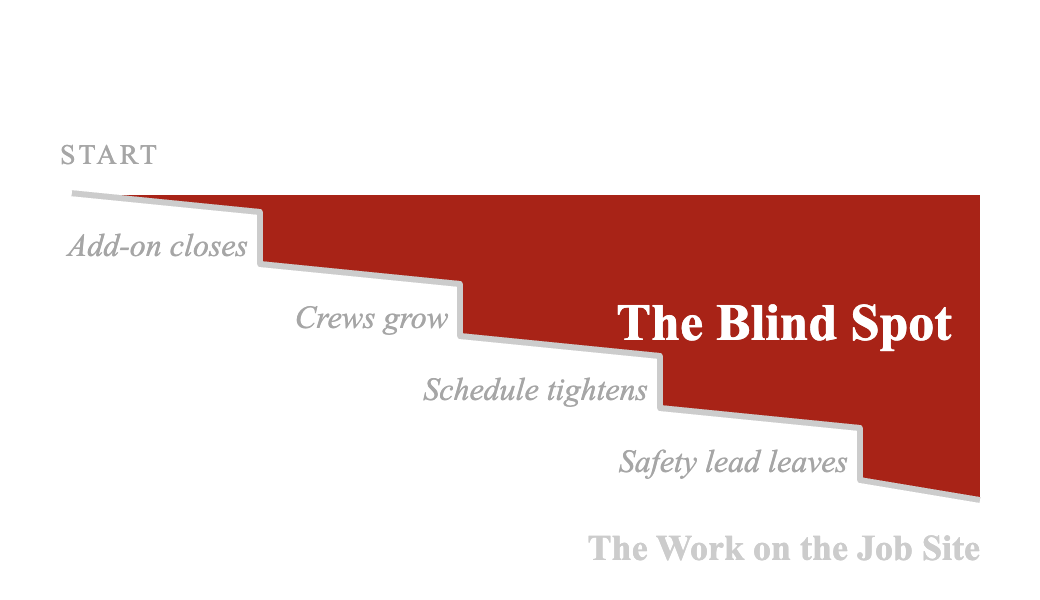
The Blind Spot
The distance between the numbers in the board report and the work on the job site.
Nobody chose it. Owners see what the reports show, and most reports were built to show what already happened. The Blind Spot grows in the space between quarters, while good management teams are busy running the business.
You’ve seen its faces
- The injury rate that looks fine until the serious injury.
- The add-on that came with its own way of doing things.
- The EMR that surfaces in diligence.
- The insurance renewal that jumps after one bad year.
- The one safety manager who carries the whole program in his head.
The Blind Spot Never Shows Up in the Board Deck. It Shows Up in Diligence.
What It Costs
What the Blind Spot Costs
On Your Returns
Claims, premiums, and stand-downs eat the margin. A rising EMR shrinks the bid list. A diligence finding can lower the multiple at exit, and a fatality can stall the sale.
On You
You own the risk without seeing the job sites, and you have to trust numbers you can’t check for yourself. The call you dread is the one that starts with a worker’s name.
The way a company keeps its crews safe is the way it runs everything else.
Your Guide
“I’ve led teams from Marine Corps infantry and boots-on-the-ground construction projects to the board rooms of some of the fastest-growing companies in the world.”Jesse Hardy, CSP
“At one company, I joined the executive team to close the HSEQ gaps before the business was sold. They gave me 24 months. We got it done in 18.”
Results
- Joined a $400M+ infrastructure services company ahead of its sale, built its corporate HSEQ group, and took serious injuries and fatalities to zero across 31 concurrent projects.
- At a right-of-way and civil contractor that grew 150% in three years, profit margin rose from 18% to 22% and EMR fell 56%.
- On a $3B+ Arctic oil development, the total injury rate fell 73% while project hours grew 231%.
Ten years in the field, project to project, then ten years leading HSEQ as a director, VP, and EVP, then 18 months back on the North Slope. CSP, MBA, and ISO 9001 Lead Auditor.
More About Jesse →The Plan
Three Steps to Close the Blind Spot
2 to 4 weeks per company
Understand the Working Reality at Every Company.
Jesse runs a Working Reality Assessment at each portfolio company: site visits, crew and leader interviews, and a review of incident, observation, and EMR data, all scored against the same eight Principles. You get one view of HSE risk across the portfolio. The same assessment works before you buy.
3 to 6 months
Set One Standard.
Each company defines its own Purpose, and every company runs on the same eight Principles and Boots On The Ground tools. Add-ons plug into a standard that already works.
Through the hold
Put It in the Field and Report It Up.
Rollout and field coaching go first to the companies with the most risk, and leading indicators reach the board every quarter.
An assessment takes two to four weeks per company. A rollout runs three to six months. Field coaching and quarterly board reporting keep it in place for the rest of the hold.
What you can count on
What’s at Stake
Two Ways This Goes
Who You Become
From Hoping the Numbers Are Right to Knowing What’s Happening on Site
Free Guide
8 Questions to Ask Before You Buy a Field Company
For private equity owners evaluating a company with crews in the field. One page, built on the eight Principles.

